Paving, from sand bed to joint
Paving In Amsterdam
Is your old paving past saving, or are you starting with a bare garden?
Clay pavers, concrete blocks and slabs laid on a build-up that suits Amsterdam ground, for front gardens, back gardens, paths and driveways
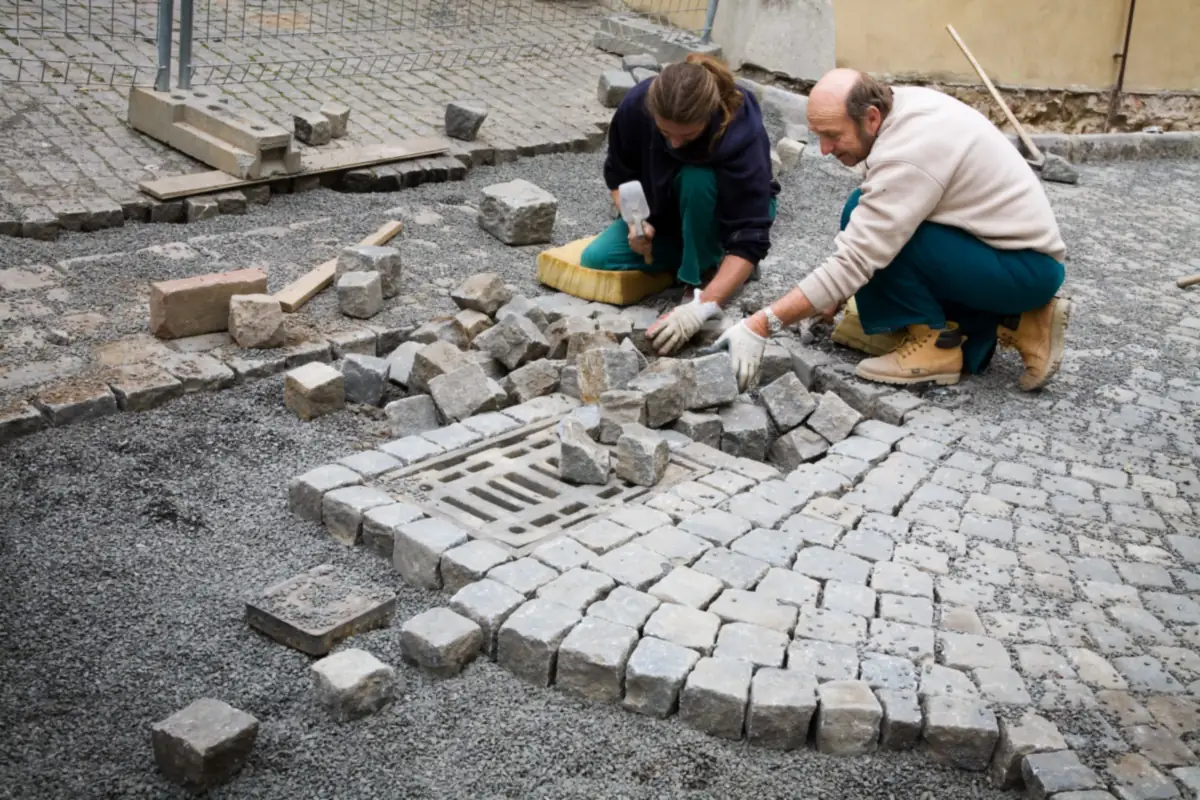
Most of the work in paving in Amsterdam is the part you never see again. Under every paver sits a sand bed compacted one layer at a time. On top of that goes a 3-5 cm bedding layer (the straatlaag) that is deliberately left uncompacted, and the whole surface falls at least a centimetre per metre so rain runs away from your house. We survey for free, write that build-up into the quote and agree a laying pattern with you that suits how the space will be used. We work from our business unit on the Daalwijkdreef in Zuidoost across all of Amsterdam and the surrounding towns, in English or Dutch.
Ask for a price per m²
- 1Tell us which area you want paved and what it will be used for
- 2We book a time to come and measure up
- 3You get a quote that spells out the build-up, the stone and the pattern
- Free site survey
- Fixed price in writing
- KLIC utility check done
- Foundation built to suit
- English & Nederlands
Why the build-up matters
Paving in Amsterdam needs more than a flat top surface
Amsterdam is low-lying, groundwater sits close to the surface, and KNMI (the Dutch met office) records an average of almost 43 frost nights a year at Schiphol (1991-2020 normals). Each of those puts demands on paving. This is what we watch for.
A fall that sheds rain
We lay to a fall of at least 1 cm per metre, away from the house. With Schiphol averaging 850 mm of rain a year, the back door is where you find out whether that was done properly.
Joints that stay full
A 2-3 mm joint brushed full of lime-free crushed-stone sand (brekerszand) keeps the pavers locked. Empty joints show up after a few winters with dozens of frosts as loose stones that rock underfoot.
A base sized to the job
For a path or patio we work on about 20 cm of build-up including the bedding layer, for a driveway 30 cm. So a garden path isn't overbuilt and a driveway isn't underbuilt.
Edges that hold
Edging kerbs (opsluitbanden) go in 2 cm below the paving surface: at least 5x15x100 cm along a patio and 8x20x100 cm along a driveway. Without that restraint, paving slowly spreads apart.
Clearance under the door
The paving finishes 1-2 cm below your door threshold. In Zuidoost, where gardens sink while the houses stay put on their piles, we work that margin out with extra care.
A stone you can check
The quote names the exact product, so you can see for yourself whether it carries KOMO certification (the Dutch product quality mark), for example under BRL 2360 for clay pavers or BRL 2312 for concrete blocks.
1
point of contact from survey to handover
m²
quotes itemised per square metre
KLIC
cable and pipe check before we dig
€0
for the site survey and advice
How we lay it
Survey to sweep-in, in seven steps
A terraced back garden in Reigersbos or a driveway in Amstelveen: the order of work never changes. Only the depths and the materials do.
- 01
Survey on site
We measure the area, look at where rainwater collects now, and note the threshold height and the state of the ground. The visit costs you nothing.
- 02
Quote with the build-up written in
You get a fixed price per m², listing the sand bed depth, the stone, the pattern and the edging. If you're applying to Amsterdam's Subsidie Groen (greening grant) for part of the garden, we split labour, materials and VAT the way the council asks for.
- 03
KLIC notification and setting out
If a machine is going into the ground, we register the dig with the Kadaster's KLIC service (the national cable and pipe check) at least three working days ahead, at €10.50 per notification in 2026. Then we set out levels and falls with string lines and pegs.
- 04
Dig-out and sand bed
Old slabs and soil come out to the right depth. The sand bed goes in in layers, and each layer gets the plate compactor. A driveway gets a base of crushed stone or broken rubble with paving sand.
- 05
Setting the edging
The kerbs go in on line and on level, 2 cm below the paving that will sit between them. Only once the edges are firm does the bedding layer go down.
- 06
Screeding and laying
On the sand bed goes 3-5 cm of clean paving sand, screeded off and not compacted. The pavers go on top in the pattern you chose. We allow around 5% extra for cutting.
- 07
Sweeping in and handover
The joints are swept full of lime-free brekerszand. Then we walk the job with you, check the fall one last time with a spirit level, and take the waste away.
- →
What next?
Start at step 1: a visit to measure up. Free, and you are not committing to anything.
Book a survey →
Commitments you can reread
What we promise is written down
Paving that starts to ripple after one winter is rarely a problem with the stones on top. The fault sits underneath: too little sand, a sub-base that was never compacted, or edging that gets pushed out the first time a car rolls over it. That is why our quote spells out more than the stone you are getting. It also states how deep the foundation goes, what we raise the level with and how the edges are held in place.
It also keeps any complaint simple. If part of the paving works loose or a strip sinks because of the way we laid it, we come back and put it right. Settlement caused by the ground itself is a different matter - peat under Amsterdam slowly compresses whatever anyone does - and we would rather tell you that up front. What we can do is build it so that raising the level later means lifting and relaying the stones, not starting again from scratch.
In writing
foundation, materials and edging are all in the quote
We return
if our workmanship is the cause, we fix it
Before you choose
What to look for in a paving contractor in Amsterdam
A price per m² over the phone doesn't tell you much. Only on site can anyone see how high the threshold is, where water sits now, and whether the back garden can only be reached through the house, which is often the case with a terraced home that has no rear access. A contractor who names a figure without looking has to deal with those things later anyway. Usually as an extra on the bill.
Ask what goes under the stone. In their laying guides, Excluton and Wienerberger (two large Dutch paving manufacturers) call for a sand bed of at least 20-30 cm, compacted layer by layer, and a heavier base of crushed stone or broken rubble under a driveway. On top comes the 3-5 cm bedding layer, which stays loose until the pavers go on. A vague answer to that question tells you most of what you need to know.
With materials, it comes down to the standard and the quality mark. Clay pavers fall under NEN-EN 1344 and can hold a KOMO product certificate based on BRL 2360; according to the Dutch clay brick association KNB, those pavers meet classes T4, FP100 and U3. Concrete blocks fall under NEN-EN 1338 with BRL 2312, concrete slabs under NEN-EN 1339 with BRL 2313. If a quote just says 'grey paver', ask which product it actually is.
Compared
Pavers or slabs for paving in Amsterdam
Four common materials side by side. Prices cover the material only, come from Homedeal's 2025 price guides and are indicative: laying comes on top, and not every source says whether VAT is included.
| Clay pavers | Concrete pavers | Concrete slabs | Porcelain slabs | |
|---|---|---|---|---|
| Standard and mark | NEN-EN 1344, KOMO via BRL 2360 | NEN-EN 1338, BRL 2312 | NEN-EN 1339, BRL 2313 | Follow the supplier's laying instructions |
| Base | Sand bed plus 3-5 cm bedding | Sand bed plus 3-5 cm bedding | Sand bed plus bedding | 2 cm thick: 15 cm recycled concrete aggregate and stabilised mortar sand |
| Joint | 2-3 mm, lime-free crushed-stone sand | At least 2 mm | At least 2 mm | At least 3 mm wide, 30 mm deep |
| Laying pattern | Herringbone, elbow or stretcher bond | Herringbone, elbow or stretcher bond | Stack or stretcher bond | Stack or stretcher bond |
| On a driveway | Yes, in herringbone or elbow bond | Yes, from 6 cm thick | Only 7 cm driveway grade, up to 60x60 | No, too thin for cars |
| Guide material price | €40-60 per m² | €20-40 per m² | €15-35 per m² | €40-80 per m² |
Laying patterns
Herringbone, elbow or stretcher bond
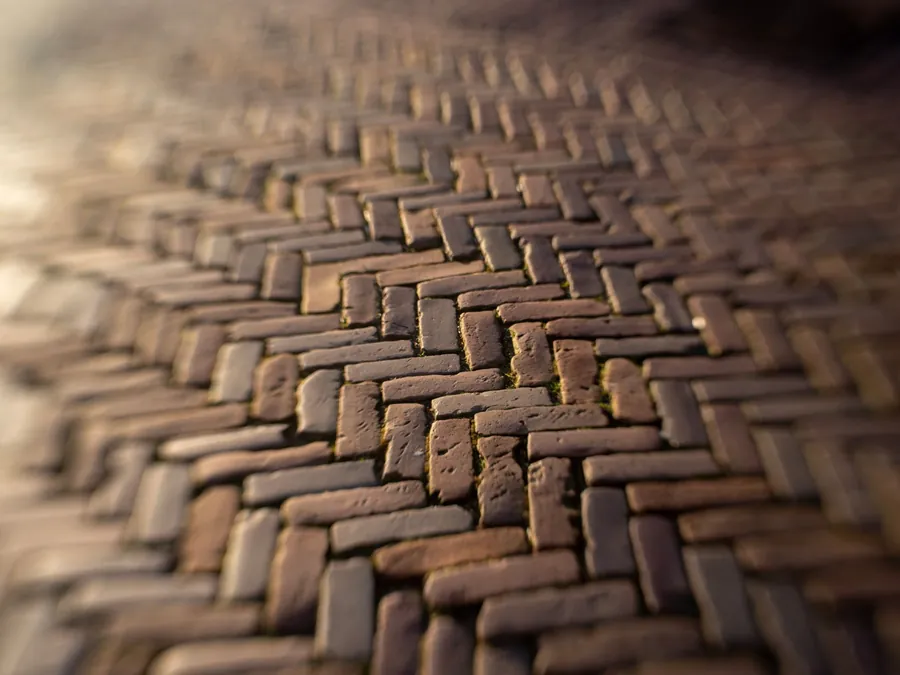
The pattern does more than set the look. The KNB calls herringbone (keperverband in Dutch) the most stable bond there is. It comes at a cost, though: every edge needs angled cuts, the little wedges Dutch pavers call bisschopsmutsen (bishop's mitres), and the bricks have to be consistently sized. Stretcher bond (halfsteens) goes down quickly with little cutting, but tends to creep in the direction cars travel. On a garden path that hardly matters. On a driveway it does.
- Herringbone: the most stable, with more cutting along the edges
- Elbow bond: firm, named by the KNB for driveway entrances and parking strips
- Stretcher bond: quick to lay, fine for paths and patios
- Random bond: attractive in a garden, but not on a driveway
- Sizes: waalformaat 200x48 mm, dikformaat 200x65 mm, keiformaat 200x98 mm
"Behind a lot of the terraced houses in the rebuilt Bijlmer, the paving is still the one laid when the house was handed over. Twenty-odd years on, what we mostly find there are washed-out joints and edges that have crept outwards."
Cost
What paving in Amsterdam costs
Homedeal's price guide puts paving including materials at €45-115 per m², VAT included. Most of the spread comes from the stone and the pattern. Labour is charged at 21% VAT, because the reduced 9% rate for work on homes doesn't cover paving. You get your own fixed price per m² after the free survey.
- €The stone: concrete slabs start at around €15 per m² for material, porcelain slabs go up to €80.
- €The pattern: herringbone means more cutting than stretcher bond, and allow for roughly 5% cutting waste either way.
- €The depth: a driveway gets around 30 cm of build-up, a path or patio about 20 cm, which changes how much soil comes out and how much sand goes in.
- €Ground in your area: around the Krulslaplantsoen in Bijlmer-Oost, Deltares estimates the ground is still sinking 1.7-6.3 mm a year, so re-paving there often needs extra sand underneath.
- €Your old slabs: if you take up part of the garden for planting, the city and Weerproof's Tegelservice collects tiles free from April to October. Otherwise we include disposal.
Guide price from
€45/m²
Indicative guide price incl. VAT for materials and laying together (Homedeal, 2025). This is not our price list: your fixed price follows the survey.
Ask for a fixed priceQuestions
Questions about paving in Amsterdam
Do I need a permit to pave my garden?
Paving your own garden usually doesn't need a permit. That changes for a national monument (rijksmonument), in a protected townscape (beschermd stadsgezicht), or if you want a new exit onto the street: in Amsterdam that needs an uitweg permit, the omgevingsvergunning for a driveway exit across the pavement. If you want to park a car in your front garden, the city's omgevingsplan (zoning plan) also applies, and it only allows parking on your own plot where, for example, a dropped entrance already exists. Run the permit check (vergunningcheck) for your address in the Omgevingsloket, because Amsterdam is bringing in its omgevingsplan area by area.
Which laying pattern is strongest for a driveway?
Herringbone and elbow bond. Wienerberger describes both as very stable and therefore well suited to a driveway. Stretcher bond is quicker to lay, but the pavers creep in the direction cars travel. Use pavers at least 6 cm thick on a driveway and don't lay them in random bond.
How deep should the sand under paving be?
Excluton works on about 20 cm of build-up for a patio or garden path, bedding layer included, and 30 cm for a driveway. Wienerberger recommends a compacted sand bed of at least 20-30 cm with 3-5 cm of fine sand or grit on top. On poorly draining ground, the KNB advises allowing for a frost-free depth of about 80 cm.
Why isn't the top layer of sand compacted?
That's how Excluton's laying guide specifies it: the 3-5 cm bedding layer is screeded and left loose. It is the layer the pavers are set to height in. The sand bed below it does get compacted, one layer at a time.
What does paving cost per m², including VAT?
Homedeal gives €45-115 per m² including materials and VAT. For labour alone, Trustoo quotes €20-40 per m² for a simple pattern and €30-45 for a complex one, without saying whether VAT is included. Labour carries 21% VAT. These are guide prices; yours follows the free survey.
Can I deal with you entirely in English?
Yes. The survey, the quote and the explanation on site can all be in English or Dutch. That helps if you haven't been in Amsterdam long and words like straatlaag or opsluitband mean nothing to you yet.
Reviews
What our customers say
Judge us on paving that is already down.
We have only just started collecting reviews, and they will appear here as they come in. Until then, ask to see photos of recent work near you when we come out to measure up. A terrace two streets away says more than five stars.
Related
Other work we do
Service area
Where we lay paving
We lay paving across Amsterdam: among the terraced houses of Gein and Reigersbos, in the garden suburbs of Nieuw-West and out on the IJburg islands. Beyond the city we work in Amstelveen, Diemen, Weesp, Abcoude and Almere, among other places.
- Amsterdam-Zuidoost
- Amstelveen
- Diemen
- Duivendrecht
- Ouderkerk a/d Amstel
- Abcoude
- Weesp
- Almere
- Badhoevedorp
- Hoofddorp
- Zaandam
- Purmerend
Get your paving built up properly
Send us the measurements or a few photos of your garden. We'll come and measure up, then send a quote that tells you exactly what goes under your stones.