Let the rain soak in
Permeable Paving In Amsterdam
Does water sit on your paving after a heavy shower?
Paving for gardens, paths and driveways that sends rain into the ground instead of the sewer
On 28 July 2014 Amsterdam's fire brigade sent out at least 30 fire engines and Station Zuid was under water. KNMI worked out that the day's heaviest reading, 131.6 mm at Deelen, now has a return period of 6 to 25 years, against 15 to 350 years in 1951. Permeable paving in Amsterdam lets part of that rain drain between or through the paving into the ground, so your garden or driveway stops funnelling everything into the drain by the back door. We can talk it all through in English or Dutch.
Get advice on rainwater
- 1Tell us where water collects now
- 2We check the soil and groundwater on site
- 3You get a proposal with the full build-up
- Free site survey
- Fixed price in writing
- KLIC utility check done
- Foundation built to suit
- English & Nederlands
What you gain
Why permeable paving in Amsterdam makes sense
Amsterdam's aim is to cope with 70 mm of rain in a single hour without damage to homes. The sewers can't do that alone, which is why Amsterdam Weerproof (formerly Rainproof) works with residents on catching rain in their own gardens. Every square metre that holds water or lets it soak away helps a little, including the one behind your house.
850 mm a year
That's KNMI's average annual rainfall at Schiphol for 1991-2020. On 24 of those days it was 10 mm or more. With sealed paving, all of it heads for your drain.
A driveway that qualifies
The guidance sheet on permeable paving from VGDO, Tuinbranche, RIONED, the Ministry of Infrastructure and Water Management and STOWA lists three types, and all three are suitable for a driveway. You don't have to choose between parking and drainage.
Less strain on your own drain
A gully that overflows in every summer shower is often just too small for the area draining into it. Let some of that water soak in where it lands and the gully has less to swallow.
No single low spot
Water running across sealed paving to one low point carries sand with it. Spread the drainage over the whole surface and there's nowhere that everything rushes to at once.
Certified products
Permeable concrete paving has its own assessment guideline, BRL 2317, which Kiwa certifies against. That tells you the units have been tested, not just labelled permeable.
Straight talk about high groundwater
Parts of Zuidoost have a high water table and kwel, groundwater pushing up from below. Only so much can soak in there. If a border or water butt would do more for your garden than different paving, we'll say so.
1
point of contact from survey to handover
m²
quotes itemised per square metre
KLIC
cable and pipe check before we dig
€0
for the site survey and advice
Our method
Laying permeable paving in Amsterdam, step by step
The real difference from ordinary paving is underneath. So every step comes back to one question: will the water actually be able to get away?
- 01
Follow the water
At the free survey we look at where water runs now, where the downpipe discharges and how close the groundwater is to the surface. That last point decides how much can soak away at all.
- 02
Build-up in writing
The quote states which type of paver we recommend, how deep the base will be and where surplus water goes once the ground is saturated. A fixed price per m², no surprises at the end.
- 03
Notify and set out
If we're digging by machine, we file a KLIC notification first (the legal check for buried cables). A new driveway with an uitweg, a driveway exit across the pavement, needs a permit, which you arrange before we dig.
- 04
A base that lets water through
A driveway needs roughly 30 cm of base, a path or patio roughly 20 cm. For permeable work that layer mustn't block the water, so we watch both the material and how hard we compact it.
- 05
Edge restraint
Kerbs along the edge keep the paving in place. A driveway gets heavier kerbs than a patio, because a car pushes against the edges every day.
- 06
Lay and fill
Pavers with spacer lugs or wide joints, grass pavers or porous blocks each get filled differently. Grass pavers have their openings filled with soil and seed; open joints get a fill that lets water through.
- 07
The hosepipe test
Before we leave we run the hose over it with you. You see where the water goes and know what to expect from the next downpour.
- →
What next?
Start at step 1: a visit to measure up. Free, and you are not committing to anything.
Book a survey →
Commitments you can reread
What we promise is written down
Paving that starts to ripple after one winter is rarely a problem with the stones on top. The fault sits underneath: too little sand, a sub-base that was never compacted, or edging that gets pushed out the first time a car rolls over it. That is why our quote spells out more than the stone you are getting. It also states how deep the foundation goes, what we raise the level with and how the edges are held in place.
It also keeps any complaint simple. If part of the paving works loose or a strip sinks because of the way we laid it, we come back and put it right. Settlement caused by the ground itself is a different matter - peat under Amsterdam slowly compresses whatever anyone does - and we would rather tell you that up front. What we can do is build it so that raising the level later means lifting and relaying the stones, not starting again from scratch.
In writing
foundation, materials and edging are all in the quote
We return
if our workmanship is the cause, we fix it
Before you choose
Choosing a contractor for permeable paving
Start with the ground, not the paver. Anyone who quotes for permeable paving without visiting can't know if your groundwater is half a metre down or far deeper. Around Krulslaplantsoen in Bijlmer-Oost, Deltares reports 2.5 to 5 mm of kwel a day, water rising from below. In a spot like that the best product on the market can only do so much, and an honest contractor will tell you.
Next comes the build-up. Purmerend shows what happens when the sand under paving starts to move: in Weidevenne, tiles sank after heavy rain, on the Amazonelaan for example. The council explained that the sand used to preload the ground in 1996 was washing away through broken or sagging sewer pipes. Water running beneath paving takes sand with it, so ask how the base is built and where the water ends up.
Finally, look at the product. Permeable concrete units can be certified under BRL 2317, while ordinary concrete block pavers fall under NEN-EN 1338 with BRL 2312. A driveway also needs units at least 6 cm thick, laid in a bond that won't creep, such as herringbone or elbow bond.
Compared
Permeable paving in Amsterdam compared
There isn't one permeable paver. These are the usual options side by side, with ordinary sealed paving for reference.
| Wide-joint or lugged pavers | Grass pavers | Gravel | Sealed paving | |
|---|---|---|---|---|
| Rainwater | Drains through the joints | Drains through the grassed openings | Drains between the stones | Runs off to a gully or sewer |
| As a driveway | Yes, per the guidance sheet | Yes, per the guidance sheet | Possible, but ruts and loose stones | Yes |
| Underfoot | Flat, like normal pavers | Green, awkward in heels | Crunchy, hard work for a suitcase | Flat |
| Upkeep | Keep the joints clean | Mow or reseed the grass | Rake and top up | Sweep, weed the joints |
| Guide price | Custom | Custom | Material €10-12/m² incl. VAT | €45-115/m² incl. VAT |
| Rules | Uitweg permit for a new driveway | Uitweg permit for a new driveway | Uitweg permit for a new driveway | No rainwater storage rule for gardens |

Grass pavers and gravel
A green driveway with permeable paving in Amsterdam
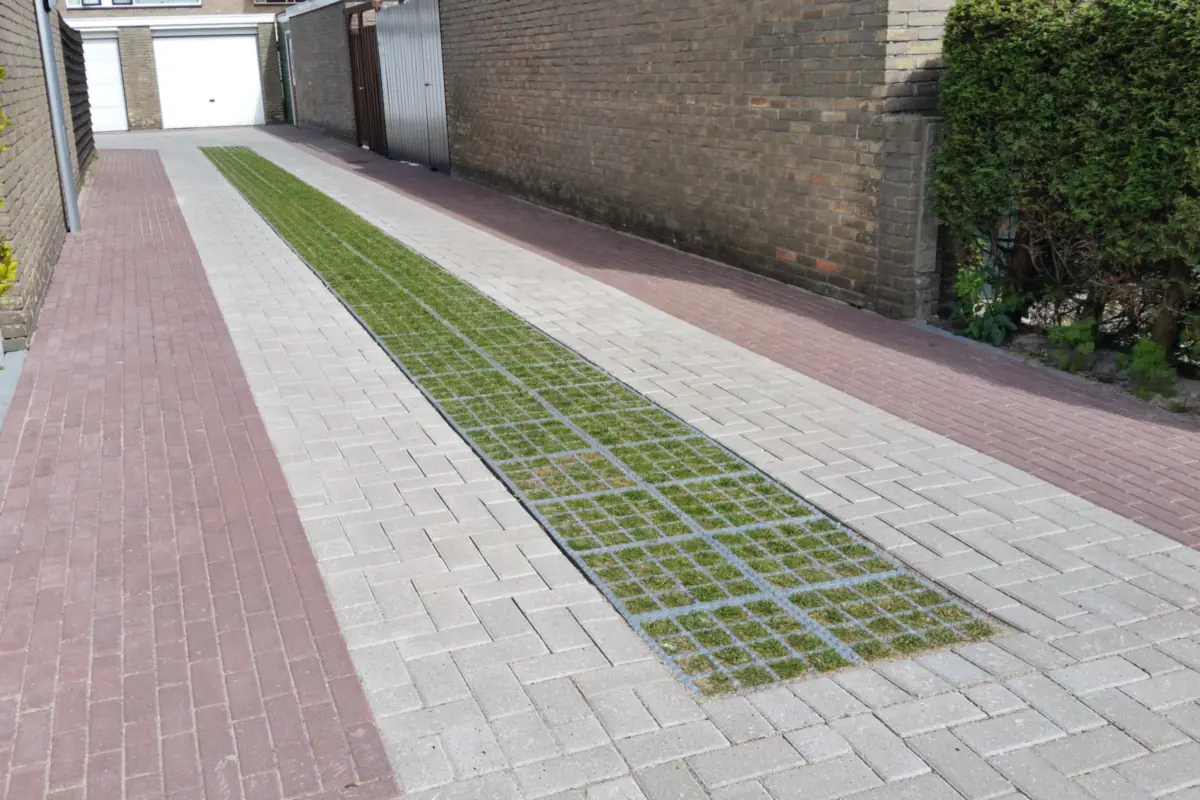
A driveway doesn't have to be a grey slab. With grass pavers, or a mix of pavers and gravel, you drive on it as normal while the rain soaks into the ground between the green. It does need a base that carries a car's weight without clogging up.
- Grass pavers, lugged pavers or porous blocks: all three suitable for a driveway
- About 30 cm of base under a driveway, designed for water and weight
- Edging kerbs that take the sideways push of car tyres
- Somewhere for water to go when the ground is full
"Most people who ring us about permeable paving have just been through a summer storm where the water came right up to the back door."
Cost
How much does permeable paving in Amsterdam cost?
We haven't found a reliable Dutch guide price for permeable paving or grass pavers. The sources that exist are Belgian or undated, and we won't hang a number on those. What we can tell you is what drives the price. After the free survey you get a fixed price per m², including 21% VAT on the labour.
- €Paver type: lugged pavers, grass pavers and porous blocks differ in both price and labour
- €Base depth: around 30 cm for a driveway against roughly 20 cm for a path
- €Groundwater level; in parts of Zuidoost with kwel, an extra outlet or border is sometimes needed
- €What's there now: old tiles and a compacted sand bed have to come out first
- €For a new driveway: the uitweg permit and any charges from the council
Guide price from
Custom
There's no reliable national guide price. After the survey you'll get a fixed price with the build-up described in full.
Ask for a fixed priceQuestions
Permeable paving in Amsterdam: your questions
Am I required to use permeable paving?
No. Amsterdam's Hemelwaterverordening (rainwater bylaw), now part of the city's omgevingsplan (zoning plan), requires rainwater storage for new buildings and certain renovations, not for paving in your garden. We haven't found any Amsterdam rule that requires permeable paving or rainwater storage for garden paving. It's your choice.
Can I build a driveway with permeable paving?
Yes. The national guidance sheet on permeable paving lists open-bond or lugged pavers, grass pavers and porous concrete blocks as all suitable for a driveway. Bear in mind that a new uitweg, the permit for a driveway exit across the pavement, needs an omgevingsvergunning (permit) in Amsterdam, and the omgevingsplan only allows parking on your own plot where there's a proper entrance. Check your address on the Omgevingsloket.
Does it work if my groundwater is high?
Less well. If the water table sits close to the surface or kwel is pushing up from below, as in parts of Zuidoost, the ground can't take much more water. In that case we look at sending the water to a border, a wadi (a shallow planted dip that holds rain) or a water butt instead. We judge that at the survey.
Is there a subsidy for permeable paving?
Amsterdam's Subsidie Groen is for removing tiles and planting the area, not for swapping tiles for different paving. The scheme as we've read it doesn't say whether grass pavers count, so check before you rely on it. If you're teaming up with at least three households, or as a school or residents' association, the AGV water authority's Geef Groen en Water de Ruimte grant may be worth a look.
How do I know a permeable paver really lets water through?
Ask about certification. Permeable concrete paving units can be certified by Kiwa under BRL 2317. It also depends on the build-up beneath: if the base blocks the water, even the best paver won't help.
Why does paving sometimes sink after a downpour?
Because running water carries sand away. In Weidevenne in Purmerend, holes opened up in gardens after heavy rain as sand washed out through broken or sagging sewer pipes. With permeable paving we make sure water spreads into the ground across the surface rather than finding one route down.
Reviews
What our customers say
Judge us on paving that is already down.
We have only just started collecting reviews, and they will appear here as they come in. Until then, ask to see photos of recent work near you when we come out to measure up. A terrace two streets away says more than five stars.
Related
More paving and garden work
Service area
Permeable paving across Amsterdam and the region
From our base in Zuidoost we work in Bijlmer-Oost, Gaasperdam, Nieuw-West, Noord and the rest of the city. We also build rain-friendly gardens and driveways in Diemen, Amstelveen, Ouderkerk aan de Amstel, Abcoude and Almere.
- Amsterdam-Zuidoost
- Amstelveen
- Diemen
- Duivendrecht
- Ouderkerk a/d Amstel
- Abcoude
- Weesp
- Almere
- Badhoevedorp
- Hoofddorp
- Zaandam
- Purmerend
Let the next downpour soak straight in
Tell us where water collects now and roughly how big the area is. We'll come and look free of charge, groundwater included, and tell you honestly whether permeable paving is the best fix for your garden.